Overview of the Annual Plan
The Public Sector Accounting Board’s (PSAB) 2026-2027 Annual Plan marks the fifth and final year of implementation of the Board’s 2022-2027 Strategic Plan. The strategic plan builds on the strong foundation PSAB built in prior years, focusing on meeting the current demands of interested and affected parties, while also anticipating and responding to the needs of the rapidly evolving Canadian public sector environment. The 2026-2027 Annual Plan marks the completion of a significant milestone for the Board with the approval of its 2027-2032 Strategic Plan. Accordingly, the annual plan continues to focus on advancing some of the Board’s significant strategic initiatives, developing several key technical projects, responding to the feedback to our 2022-2023 Future Work Plan Consultation Paper, and conducting other outreach activities.
Based upon feedback to our 2022-2023 Future Work Plan Consultation, PSAB intends to initiate the following technical projects in fiscal 2026-2027:
- impairment of assets held for service potential (non-cash generating assets); and
- major amendments to Section PS 2120, Accounting Changes.
The annual plan allocates staff resources to analyze feedback from PSAB’s Exposure Draft, “Intangible Assets, Proposed Section PS 3155,” and to develop the cloud computing arrangements guideline. In addition, the annual plan includes the development and publication of a feedback statement to address responses to the Financial Instruments Monitoring and Post-implementation Review Assessment projects, and the development of a project proposal for a narrow-scope amendment to the financial instruments suite of standards. Staff will also conduct a post-implementation review assessment of Section PS 3280, Asset Retirement Obligations, to evaluate if the standard meets its objectives and to assess the nature and extent of the implementation challenges.
In addition, the 2026-2027 Annual Plan commits resources for researching Phase II of the Employee Benefits project, and for developing an exposure draft for the second standard-level project to implement the Government Not-for-Profit (GNFP): Contributions and Financial Statements Presentation.
To strengthen PSAB’s Indigenous Engagement Strategy and International Strategy, the 2026-2027 Annual Plan includes resources for meeting with the Indigenous Advisory Group and the Technical Advisory Group to gather input on a variety of topics. The Board will also support the Canadian Sustainability Standards Board (CSSB) on sustainability-related matters.
Our Strategies and Activities
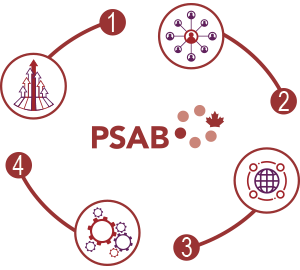

Strategy 1: Develop relevant and high-quality accounting standards
Activities
- Complete communication activities to support the issuance of Section PS 3251, Employee Benefits, concluding Phase I of the Employee Benefits project. Conduct research to inform Phase II, focusing on non-traditional pension plans.
- Review feedback to the Exposure Draft, “Intangible Assets, Proposed Section PS 3155,” revising as needed.
- Develop an exposure draft for the Cloud Computing Arrangements guideline project.
- Develop an exposure draft for the Contributions and Financial Statement Presentation project as part of the GNFP Strategy.
- Begin analyzing issues that will help inform the development of exposure-draft proposals for the impairment of assets held for service potential (non-cash generating assets).
- Develop a feedback statement to address the responses to PSAB’s Financial Instruments Monitoring and Post-implementation Review Assessment projects.
- Develop an exposure draft proposing major amendments to Section PS 2120, Accounting Changes, that address issues raised through the PSAB Future Work Plan Consultation Paper.
- Conduct a post-implementation review assessment for Section PS 3280, Asset Retirement Obligations.
- Co-ordinate Technical Advisory Group meetings to review PSAB’s responses to the International Public Sector Accounting Standards Board’s (IPSASB) documents for comment and support technical review of other items as needed by PSAB.

Strategy 2: Enhance and strengthen relationships with our interested and affected parties
Activities
- Meet with the Indigenous Advisory Group throughout the year.
- Undertake communication activities to raise awareness with PSAB’s interested and affected parties of the IPSASB’s standard setting and research projects.
- Maintain and promote the Public Sector Accounting Discussion Group as the leading forum for discussions and deliberations.
- Strengthen engagement using virtual and in-person outreach activities, such as roundtables, conferences, and webinars.
Inform interested and affected parties of technical agenda items and key decisions made at our meetings and update them on the progress of projects.

Strategy 3: Enhance and strengthen relationships with other standard setters
Activities
- Maintain support for the Canadian IPSASB member.
- Strengthen PSAB’s working relationships with the IPSASB staff.
- Support the CSSB’s work in developing public sector sustainability standards.

Strategy 4: Support forward-looking accounting and reporting initiatives
Activities
- Provide the Canadian perspective to IPSASB’s accounting proposals and documents for comment, including consulting Canadian interested and affected parties.
- Monitor the development of other relevant international standards, such as those from the International Sustainability Standards Board, International Accounting Standards Board, and the Governmental Accounting Standards Board
- Issue PSAB’s 2027-2032 Strategic Plan Consultation Paper, deliberate feedback, revise as needed, and approve the final strategic plan.
Our Due Process and Governance
Key Accountabilities for 2026–2027
Conduct PSAB’s 2026-2027 Annual Plan activities in line with our Due Process, our Terms of Reference, and our approved budgets by:
- providing the Reporting & Assurance Standards Oversight Council (Oversight Council) with progress updates;
- demonstrating our compliance with due process;
- providing interested and affected parties with updates on key decisions made at our meetings;
- publishing an annual plan and annual report; and
- using financial resources effectively and efficiently.
Monitoring for Success
To ensure that we achieve the goals set in our annual and strategic plans, we monitor our progress and actively identify and manage our risks. This risk management process includes identifying mitigating controls and monitoring developments in the business environment to ensure that we remain adaptive to the needs of our ever-changing environment. The Oversight Council oversees our activities and assesses our performance for the year to ensure that we fulfill our public interest mandate.