Overview
This 2026-2027 Annual Plan is based on the vision, mission, and strategic objectives set out in our 2022-2027 Strategic Plan, which focuses on enhancing the relevance of financial and non-financial information reported to meet the evolving information needs of Canadian interested and affected parties. We recognize that the financial reporting environment is evolving rapidly – driven by technological innovation, political and environmental factors, and a continued demand for decision-useful information. As we complete the final year of our 2022-2027 Strategic Plan, we will be consulting on our next strategic plan that includes strategies for 2027 and beyond. Our new strategies will build on our achievements while positioning us to address emerging challenges and future opportunities.
Our Annual Plan outlines the activities we plan to undertake this year. In this dynamic environment, we remain committed to delivering high-quality accounting standards for every major reporting entity category in Canada’s private sector: publicly accountable enterprises, private enterprises, not-for-profit organizations (NFPOs), and pension plans.
We will continue to maintain robust engagement with the International Accounting Standards Board (IASB) and leverage our roles as Co-Chair of the International Forum of Accounting Standard Setters (IFASS) and member of the Accounting Standards Advisory Forum (ASAF) to ensure Canadian perspectives are considered in the development of IFRS® Accounting Standards. We will use our advisory committees to support the implementation of new standards and influence IASB proposals. This work is critical to maintaining the usefulness of IFRS Accounting Standards for Canadian publicly accountable enterprises.
We will advance our various projects on domestic standards and continue to apply our Guidance Framework to address issues to support interested and affected parties in applying our standards. Our focus this year includes beginning work on topics identified as higher priority by interested and affected parties through our Detailed Review of Accounting Standards for Private Enterprises project, and advancing the Relief from Recognition of Acquired Intangible Assets and Amortization of Goodwill project. We will also consult with the NFPO sector by issuing an exposure draft on our Contributions project and a consultation paper on our Reporting Controlled and Related Entities project. In addition, we plan to conduct research to better understand the current pension landscape.
Canadian reporting needs are evolving, with a continued emphasis on decision-useful information that goes beyond the traditional financial statements. Guided by our 2022-2027 Strategic Plan, we aim to support these needs by delivering high-quality accounting standards, while being mindful of the boundaries of what information is contained in the financial statements. Through active engagement with interested and affected parties, including financial statement users, we will ensure standards provide decision-useful information and are cost-effective for preparers to apply.
As we carry out the activities outlined in this Annual Plan, we will closely monitor shifts in the economic environment and any challenges that arise for our interested and affected parties. This includes assessing the effects of technological advancements, including artificial intelligence (AI), for financial reporting to ensure that our standard-setting process remains robust and continues to serve the public interest effectively. We remain flexible and are prepared to adjust our plan as circumstances evolve.
Back to top

Strategies for Each Part of the CPA Canada Handbook – Accounting
Part I: Support the application of IFRS Accounting Standards in Canada
Our objectives
We believe that supporting implementation starts at the beginning of a standard’s development. As a result, we will continue working to influence the IASB throughout its standard-setting process, leveraging our reputation to make advancements. We will also work to provide a direct line of contact to the IASB for interested and affected parties whenever possible.
We support interested and affected parties with implementation through targeted activities:
- Influence: We will perform the appropriate level of consultation on documents for comment issued by the IASB to the extent they are relevant to Canadian interested and affected parties.
- Monitor: We will closely monitor for application issues related to emerging issues and newly issued amendments. Our IFRS® Accounting Standards Discussion Group is an important part of all these activities. We will work with this Group to identify implementation issues affecting Canadians through open communication and robust agendas.
- Committee support: We will maintain an open dialogue with our advisory committees as needed, including the Academic Advisory Committee and User Advisory Committee, to ensure Canadian-specific issues are considered. We will also use our newly established Rate-regulated Activities Transition Resource Group to support the implementation of the forthcoming new standard and our Risk Mitigation Accounting Working Group to consider how the IASB proposals may impact specific industries in Canada.
Similar financial reporting outcomes under IFRS Accounting Standards and U.S. generally accepted accounting principles (GAAP) are highly important for interested and affected parties. We will continue to work toward narrowing new, unnecessary differences in financial reporting outcomes under IFRS Accounting Standards and U.S. GAAP by regularly engaging with the IASB and U.S. Financial Accounting Standards Board. We will also continue our strategic collaborations with other national standard setters, including in our role as Co-Chair of IFASS.
Part II: Continue to establish appropriate accounting standards for private enterprises
Our objectives
Our main priorities for 2026-2027 continue to be improving financial reporting for private enterprises and addressing areas that are causing them difficulties. Our Consultation Paper, “Detailed Review of Accounting Standards for Private Enterprises (ASPE),” helped us to identify topics that interested and affected parties find challenging to apply. Based on this feedback, we will begin work this year on topics that respondents identified as higher priority and for which there is broad support for potential proposals discussed in the Consultation Paper. The work will focus on researching the topic of related party transactions and developing guidance on the topic of impairment of long-lived assets. We will also publish a feedback statement to outline other priority topics, which we will address in future years, resulting from the Detailed Review of ASPE. We will deliberate feedback on the proposals from our Exposure Draft, “Relief from Recognition of Acquired Intangible Assets and Amortization of Goodwill,” and work toward finalizing the project to provide simplification and optionality in Part II of the Handbook – ASPE.
We will also continue to advance toward developing an exposure draft of an updated conceptual framework for Part II of the Handbook and Part III of the Handbook – Accounting Standards for NFPOs. This project aims to clarify the purpose and intended use of financial statement concepts. It will develop updated financial statement concepts for Parts II and III of the Handbook in areas that will assist preparers and practitioners when applying GAAP and the AcSB when setting standards.
Our Private Enterprise Advisory Committee, Medium and Small Practitioners Advisory Committee and Canadian Private Enterprise User Advisory Committee will continue to play key roles in supporting the development of high-quality accounting standards. They do this by identifying and discussing application issues using our Guidance Framework and providing recommendations to address them. We are also continually listening to interested and affected parties to ensure we are aware of new and emerging issues facing Canadian private enterprises. In 2026-2027. we plan to start project work that addresses specific issues arising from the Guidance Framework that require standard-setting activity.
Part III: Continue to establish appropriate accounting standards for NFPOs
Our objectives
We are dedicated to ensuring NFPO standards reflect the current environment and supporting interested and affected parties in applying the standards. We aim to foster meaningful engagement with the not-for-profit sector as we prepare to issue an exposure draft for our Contributions project. In addition, we plan to seek input from the sector through a consultation paper on the reporting of controlled and related entities by NFPOs.
We will look to our Not-for-Profit Advisory Committee for support as we advance our projects for NFPOs. The Committee will also identify and discuss application issues using our Guidance Framework and provide recommendations to address them.
Part IV: Enhance the relevance of accounting by pension plans
Our objectives
We will continue to ensure that standards in Part IV of the Handbook – Accounting Standards for Pension Plans meet the sector’s needs.
We plan to build on the feedback we gathered from our work-plan survey and focus on conducting research on pension plans that are not traditional defined benefit or defined contribution plans to ensure the standard remains appropriate given the evolving pension landscape.
In addition, we will work with our Pension Plan Advisory Committee to identify current challenges in the sector to inform our work in Part IV of the Handbook and use our Guidance Framework to provide additional support to pension plans, as needed.
Back to top

Support Improving the Quality of Reporting Beyond the Traditional Financial Statements
Our objectives
During this year, we are also developing our next strategic plan, which will guide our work from 2027 onward. As developments in our environment continue to influence what is reported within and beyond financial statements, our strategy is evolving to ensure that our standards remain relevant in reporting useful information.
We continue to see rapid change in the reporting needs of Canadian entities. In addition, capital providers, investors, and interested and affected parties are demanding more transparency and decision-useful information beyond what is currently available in the traditional financial statements. As a result, we are focused on identifying how best to support Canadian needs, while remaining attentive to how information beyond the financial statements can influence the understanding of financial statements.
To inform this work, we will continue to seek input from financial statement users through our User Advisory Committee and Canadian Private Enterprise User Advisory Committee to better understand the information they rely on, both within and beyond the traditional financial statements. This feedback will help us in ensuring that our standards remain a useful source of information for informed decision making. At the same time, we will work closely with interested and affected parties to consider the boundaries of information that should be reported in financial statements.
As we perform these activities, we remain aware of the impact that technological advancements, including AI, are having on the accounting profession. We will conduct research to understand how these developments are changing the way financial information is consumed and the way our standards are being applied, to inform how we perform our standard-setting activities.
Back to top

Grow the AcSB’s International Influence
Our objectives
We are proud of the strong international reputation we have built for Canadian standard setting – a success made possible through the engagement and support of interested and affected parties across the country. Serving as IFASS Co-Chair reflects this achievement and highlights our leadership on the global stage.
As we move into fiscal 2026-2027, a key focus will be ensuring that the IASB considers Canadian viewpoints. This work is essential to ensure IFRS Accounting Standards produce useful information for publicly accountable entities in Canada. Our recognized standing as a global leader in standard setting will support us in fulfilling this objective.
We will advance global standard setting by providing thought leadership and global best practices for all major reporting entity categories in Canada’s private sector, while leveraging insights from our international activities to enrich the development of our Canadian domestic standards.
To do this, we will continue to:
- maintain and grow strong strategic collaborations with standard setters around the world to amplify Canadian views on IFRS Accounting Standards, and discuss issues faced by private enterprises, NFPOs, and pension plans in Canada;
- contribute at international meetings, such as ASAF, World Standard Setters, and IFASS, by sharing Canadian perspectives and practices on relevant issues; and
- support any Canadian(s) appointed to the IASB or international committees, and recommend Canadians for appointments when opportunities arise.
Back to top

Monitor for Success
Due process
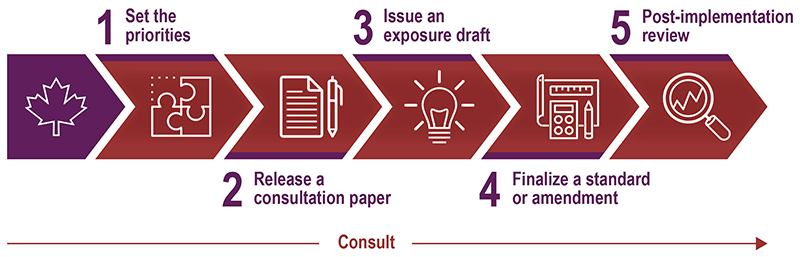
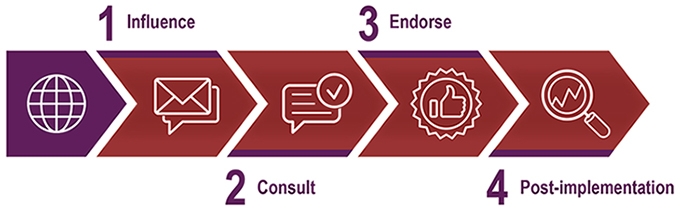
Our due process is based on three principles: transparency, consultation, and accountability. These principles permeate the due process procedures we follow when determining the content of the Handbook applied by all reporting entities in Canada.
Domestic accounting standards due process
IFRS® Accounting Standards due process
We are committed to following our due process in each decision we make and will consider other factors when applying due process to address extenuating circumstances. We will continue to look for ways to promote transparency in what we do. We aim to be even more accessible to interested and affected parties and expand the reach of our consultation activities. This is essential to our work.
Our overarching goals for governance also mean ensuring interested and affected parties can hold us accountable and understand the decisions we make. To support this, we will be clear, timely, and concise when sharing information.
Communications
The quality of everything we do is directly related to ensuring the lines of communication are open to interested and affected parties.
Our focus will include tailoring messaging to engage a diverse audience, aiming to increase awareness and participation to gather valuable feedback for our activities. In addition, we will continue to use available technologies to explore new ways of engaging with interested and affected parties.
Our risks
To make sure we achieve the goals set in our annual and strategic plans, we monitor our progress and identify and manage our risks effectively. This risk management process includes identifying mitigating controls and monitoring developments in the business environment. This helps ensure we know when to change our standard-setting approach.
Many of the key risks we manage are operational in nature. We acknowledge that the current political and economic environment may increase demand from interested and affected parties for support in applying our standards. To address these demands, we will continue to apply our Guidance Framework. In addition, remaining relevant to interested and affected parties is a key priority to managing our strategic and reputational risks. Therefore, we are committed to staying nimble and re-evaluating priorities as needed. This includes trying new and innovative ways to progress projects and effectively engage with interested and affected parties.
Deliverables and timelines
Our project plan is based on best estimates of current staffing levels, AcSB-approved projects for domestic standards, and the latest information on the IASB’s work plan. We are ready to change our plans to ensure interested and affected parties are well served. We will communicate any changes and the reasons for them in a clear and timely manner.
Stay up to date on our current projects and activities:
Also see the IASB's work plan for additional information on IFRS Accounting Standards projects and the AcSB’s decision summaries that follow every meeting, outlining the work we do on domestic accounting standards and IFRS Accounting Standards.
For an overview of our past achievements, read our Annual Report.
Back to top