This section highlights revisions related to evaluating:
- the relevance and reliability of information intended to be used as audit evidence; and
- the accuracy and completeness of information produced by the entity.
This section presents key proposed changes, explains why they are important, and where relevant, identifies key scalability considerations. Relevant references to the IAASB’s Exposure Draft are also provided.
Evaluating the relevance and reliability of information intended to be used as audit evidence
Key proposed changes
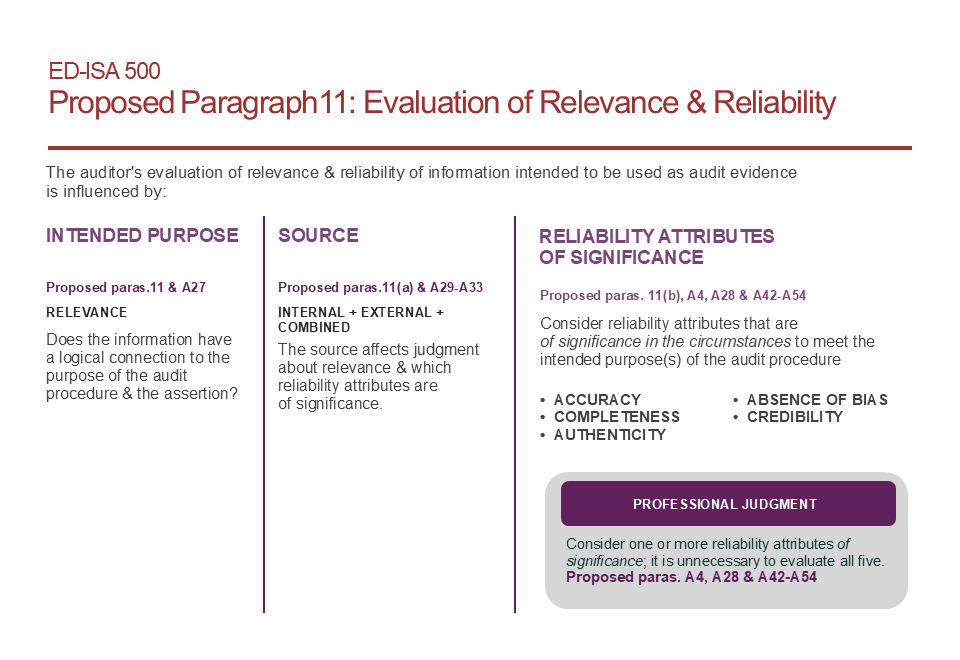
- Proposed paragraph ISA 500.11 strengthens the extant requirement by requiring the auditor to evaluate, rather than consider, the relevance and reliability of information intended to be used as audit. As part of this evaluation, the auditor is required to consider:
- the source of the information; and
- the attributes of reliability that are “of significance in the circumstances to meet the intended purpose(s) of the audit procedures.” This introduces a new threshold “of significance in the circumstances” for evaluating reliability.
- Proposed requirement in paragraph ISA 500.13 clarifies when a separate evaluation is necessary. The evaluation of the relevance and reliability of information may be performed as part of designing and performing the audit procedures required by proposed paragraph ISA 500.9. To the extent that this evaluation has not already been addressed through those procedures, the auditor performs a separate evaluation in accordance with proposed paragraph ISA 500.13.
The PDF below provides an overview of how proposed paragraph ISA 500.11 can be applied.
Why it matters
- The ease of access to information increases the risk that auditors may inadvertently use information that is not sufficiently reliable as audit evidence.
- A robust approach to evaluating the relevance and reliability of information intended to be used as audit evidence strengthens the quality of audit evidence obtained.
- Proposed paragraph ISA 500.11(b) addresses scalability by requiring the auditor to consider only reliability attributes that are “of significance in the circumstances to meet the intended purpose(s) of the audit procedures”. Such considerations include the exercise of professional judgment, and does not require evaluating all attributes of reliability, but rather only those judged by the auditor to be of relative importance in the context of the specific audit procedure. Key scalability consideration
- Flexibility in how the evaluation is performed is built into the requirements to recognize that it may be an integral part of the audit procedures themselves under proposed paragraph ISA 500.9 or a separate evaluation under proposed paragraph ISA 500.13. Key scalability consideration
Relevant sections
ED-ISA 500
- Explanatory Memorandum – Section 1–D, paragraphs 33-42.
- Proposed paragraphs ISA 500.11, 13, A1-A4, A27-A33, and A42-A61.
Overall ED
- Explanatory Memorandum – Section 1-A, paragraph 33
Evaluating the accuracy and completeness of information produced by the entity
Key proposed changes
- Proposed paragraph ISA 500.12 retains the extant requirement related to evaluating the accuracy and completeness of information produced by the entity but introduces a clearer threshold “to the extent necessary” to reflect the scalability in the extent of the auditor’s evaluation.
- Proposed application material explains what is captured by the phrase “information produced by the entity”. This includes:
- information generated internally from the entity’s information system; and
- outputs generated by the entity’s information system that incorporates external information.
Why it matters
- Using the phrase “to the extent necessary” supports scalability by allowing the extent of work on accuracy and completeness to vary based on the circumstances and intended purpose of the audit procedure. Key scalability consideration
- Reinforces the importance of evaluating accuracy and completeness when using information produced by the entity, and clarify the type of information captured by the requirement.
Relevant sections
ED-ISA 500
- Explanatory Memorandum – Section 1–D, paragraphs 43-46.
- Proposed paragraphs ISA 500.12, A34, A45, and A61.