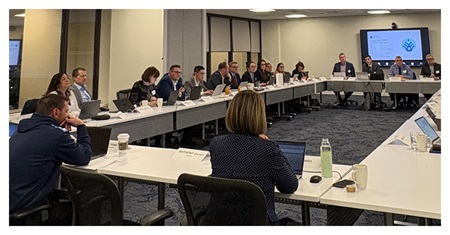
On October 30, 2025, the Auditing and Assurance Standards Board (AASB) partnered with the International Auditing and Assurance Standards Board (IAASB) to host an in-person Technology Quality Management roundtable in Toronto. We were pleased to welcome IAASB representatives Tom Seidenstein (Chair), Nancy Cheng (Board member), Willie Botha (Program and Senior Director), Angelo Giardina (Principal), and Kevin Reinhardt (Staff Fellow).
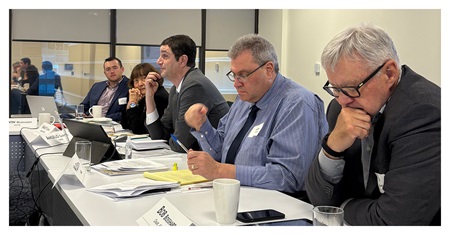
This Canadian session was part of the IAASB’s global outreach series, exploring how emerging technologies – especially artificial intelligence (AI) – are used in audit and assurance engagements, and how quality management standards apply to these tools.
The roundtable brought together 25 attendees from across the external reporting ecosystem, including practitioners from firms of various sizes, regulators, professional accounting organizations, tool providers, and other users of audit reports.
The IAASB received valuable input to help determine what additional support it can provide to help firms and practitioners operationalize the principles in the quality management standards for emerging technologies.
The AASB’s participation in IAASB initiatives ensures that Canadian perspectives are heard and considered, since the IAASB’s quality management standards are adopted in Canada as:
- Canadian Standard on Quality Management (CSQM) 1, Quality Management for Firms that Perform Audits or Reviews of Financial Statements, or Other Assurance or Related Services Engagements, and
- Canadian Auditing Standard (CAS) 220, Quality Management for an Audit of Financial Statements.
This publication summarizes the key insights from our Canadian session, outlines the next steps the IAASB is taking, and highlights how you can contribute to its future direction.
Why the IAASB Undertook the Outreach
Firms have long relied on technological tools that operate in transparent and predictable ways, supported by well-established quality management and certification processes. Emerging technologies, such as generative AI, machine learning, and advanced automation, are transforming audit and assurance engagements. As these technologies become more widely adopted, they offer opportunities to enhance engagement quality and efficiency. However, they also raise new challenges when applying quality management standards, particularly when the technology’s underlying logic is difficult to interpret, when outputs vary even for the same input, or when tools change over time.
In response to these challenges, the IAASB launched the Technology Quality Management Workstream in June 2025. The goal was to gather information through global outreach on how the IAASB’s quality management standards are being applied to emerging technologies and assess whether additional support is needed to facilitate their consistent application. This workstream builds on the IAASB’s Technology Position, which emphasizes the IAASB’s commitment to facilitate and, where appropriate, encourage firms and practitioners to use technology in their systems of quality management and in their engagements.
What We Heard in Canada
The themes raised in the Canadian roundtable are broadly consistent with what the IAASB heard around the world. You can read the full global feedback.
Key Takeaways
- The value of AI adoption lies in supporting higher-quality audits.
- Human oversight remains essential. Skills such as judgment, skepticism, accountability, coaching, and mentoring are increasingly important for responsible AI use.
- Existing quality management standards are fit for purpose but would benefit from non-authoritative material to support consistent application.
- Guidance should be scalable and proportionate to various firm sizes, levels of AI adoption, and technological infrastructure.
Themes in Detail
The roundtable consisted of four sessions, which are summarized below.
Session 1: Current and future uses of AI in engagements
Session 2: Applying the quality management standards
Session 3: Expectations of others in the external reporting ecosystem
Session 4: IAASB’s role
Session 1: Current and future uses of AI in engagements
Participants discussed how emerging technologies are used in engagements today and how their use is expected to evolve in the future.
AI use cases: Today
Participants shared current AI use cases, such as:
- enhancing productivity tasks (e.g., document extraction, summarization, meeting notes, and drafting communications);
- using chatbots (e.g., querying methodology and standards);
- cleansing and transforming client data to enhance analytics;
- reviewing client documents and engagement team working papers; and
- strengthening risk assessment (e.g., anomaly detection and financial statement analysis).
Looking ahead: The future of AI
Participants described several potential AI opportunities:
- Process transformation – Continuous auditing and leveraging real-time client and external data for issue detection.
- Advanced capability – Authentication of audit evidence, processing unstructured client data for corroboration, and risk-based sampling.
- Autonomous and integrated systems – Autonomous decision-making agents and interconnected technology working as a unified ecosystem.
- Supervision and coaching – Smart agents providing proactive prompts and guidance to staff.
- Judgment and valuation – Enhanced estimation capabilities that support higher-value insights for clients.
Session 2: Applying the quality management standards
Participants shared their practical experiences with applying quality management standards to emerging technologies.
- CSQM 1 includes a requirement and guidance for firms using technological tools on engagements. Specifically, paragraph 32(f) requires that a firm establish the following quality objective:
“Appropriate technological resources are obtained or developed, implemented, maintained, and used, to enable the operation of the firm’s system of quality management and the performance of engagements" [emphasis added].
The related application material provides guidance on what “appropriate” means in this context.
- CAS 220 describes the responsibilities of engagement partners and teams by addressing engagement resources. This includes technological tools made available by the firm (e.g., tools certified by the firm for use).
Quality management standards remain fit for purpose
The principles in CSQM 1 and CAS 220 are fit for purpose and can address risks from emerging technologies.
How firms are managing AI-related risks today
Participants shared several ways they are managing quality when using AI tools, including:
- human involvement at critical points in the audit;
- establishing centralized certification processes for firm‑level tools;
- requiring rigorous validation of inputs and outputs for engagement‑level tools;
- applying risk‑based testing, with baseline testing for all tools and additional testing for higher-risk tools;
- putting safeguards and limits on how AI tools can be used in engagement files; and
- providing mandatory AI training before staff can use the tools, along with ongoing training as tools evolve.
Guidance will help with consistent application
Participants shared challenges where guidance may be helpful:
- Governance and accountability – How to build robust governance frameworks for emerging technologies, including when responsibilities span global networks, local firms, and engagement teams.
- Inputs and outputs – How to validate and document AI inputs and outputs when the technology has limited transparency.
- Tool certification and monitoring – When tools are evolving, how often should they be tested or recertified, which aspects require ongoing monitoring (including relevant general IT controls), and how risk-tolerance levels should be set.
- Oversight of third-party tools – How to evaluate vendor‑developed tools, establish certification criteria, and implement monitoring practices to manage third‑party risk.
- Direction, supervision, and review (DSR) – How to demonstrate effective DSR, professional judgment, and professional skepticism when AI is involved.
Session 3: Expectations of others in the external reporting ecosystem
Participants – mainly regulators, professional accounting organizations, tool providers and other users of audit reports – shared their views on how emerging technologies should be governed to maintain trust in audit engagements.
Transparency
- Participants noted the value of open communication with those charged with governance about the AI used by both the auditor and the entity.
- They also discussed whether transparency with users about the use of AI in the audit could help build trust in the short term, until its use becomes more widespread.
Governance
Effective AI governance requires addressing a range of risks, including:
- ethical and reputational risks;
- legal and accountability considerations;
- explainability; and
- data privacy and third‑party risks.
Documentation
Documentation continues to be important to:
- demonstrate that professional judgment was applied;
- show consideration of contradictory evidence; and
- support results that can be replicated.
Session 4: IAASB’s role
Participants discussed how the IAASB can best support clarity, consistency, and acceptance of quality management principles as firms and practitioners adopt emerging technologies.
Guidance will help operationalizing quality management principles for emerging technologies
Participants agreed that the principles in the quality management standards remain fit for purpose and capable of addressing risks from emerging technologies.
They encouraged the IAASB to:
- use non-authoritative materials in the form of guidance to clarify how these standards apply to emerging technologies used in engagements; and
- issue shorter, easy-to-digest guidance to provide timely support.
Scalable and proportionate guidance
Participants emphasized the need for guidance that:
- is scalable and proportionate for firms of all sizes, recognizing that governance and technology capabilities vary across firms; and
- includes practical examples for small and medium-sized practices, including how to evaluate and document the use of third-party tools and service providers.
What’s Next?
At its December 2025 meeting, the IAASB reviewed the feedback on its global outreach and agreed to pursue the development of non-authoritative materials.
At its March 2026 meeting, the IAASB will discuss a proposed action plan to develop non-authoritative materials, including identifying appropriate themes and topics, and the nature, scope, and expected timing of deliverables.
These materials are intended to give firms and practitioners practical guidance and support. They are not part of the standards and will not add any new requirements.
The AASB will continue elevating Canadian views to the IAASB and actively contribute to shaping any potential guidance. Stay up to date on this important initiative by visiting the Technology Quality Management Workstream project page.
Opportunity to Share Your Thoughts
Connect with us to share how you apply CSQM 1 and CAS 220 to emerging technology, and any challenges you are experiencing. Your insights help us understand what guidance would be most helpful to you as we continue to advance Canadian perspectives to the IAASB. Please contact Jasmine Saini by email to share your feedback.